Normal

Publicación sobre Inteligencia Artificial

https://editorialia.com/wp-content/uploads/2020/02/image-11.png

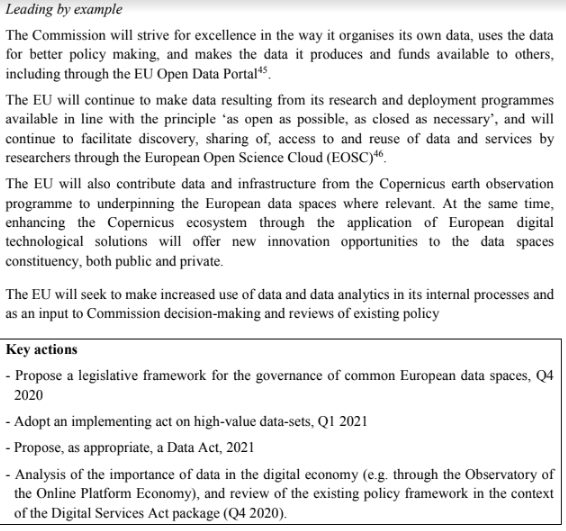
A European strategy for data

The EU can become a leading role model for a society empowered by data to make better decisions -in business and the public sector. To fulfil this ambition, the EU can build on a strong legal framework – in terms of data protection, fundamental rights, safety and cybersecurity and its internal market with competitive companies of all sizes and varied industrial base.
In the period 2021-2027, the Commission will invest in a High Impact Project on European data spaces and federated cloud infrastructures.

WHITE PAPER On Artificial Intelligence – A European approach to excellence and trust

The purpose of this White Paper is to set out policy options on how to achieve these objectives. It does not address the development and use of AI for military purposes.The Commission invites Member States, other European institutions, and all stakeholders, including industry, social partners, civil society organisations, researchers, the public in general and any interested party, to react to the options and to contribute to the Commission’s future decision-making in this domain.

https://editorialia.com/wp-content/uploads/2020/06/learning-scala-language.jpg

Learning Scala Language

Learning Scala Language eBook. (Stack Overflow Documentation).

Scala is a modern multi-paradigm programming language designed to express common programming patterns in a concise, elegant, and type-safe way. It smoothly integrates features of object-oriented and functional languages.

https://editorialia.com/wp-content/uploads/2020/06/python-data-science-handbook-essential-tools-for-working-with-data.jpg

Python Data Science Handbook (Essential Tools for Working with Data)

For many researchers, Python is a first-class tool mainly because of its libraries for storing, manipulating, and gaining insight from data. Several resources exist for individual pieces of this data science stack, but only with the Python Data Science Handbook do you get them all—IPython, NumPy, Pandas, Matplotlib, Scikit-Learn, and other related tools.

https://editorialia.com/wp-content/uploads/2020/02/matlabgrow.png

MATLAB® Notes for Professionals book

This MATLAB® Notes for Professionals book is compiled from Stack Overflow Documentation. (182 pages, published on May 2018)

https://editorialia.com/wp-content/uploads/2020/06/a-whirlwind-tour-of-python.jpg

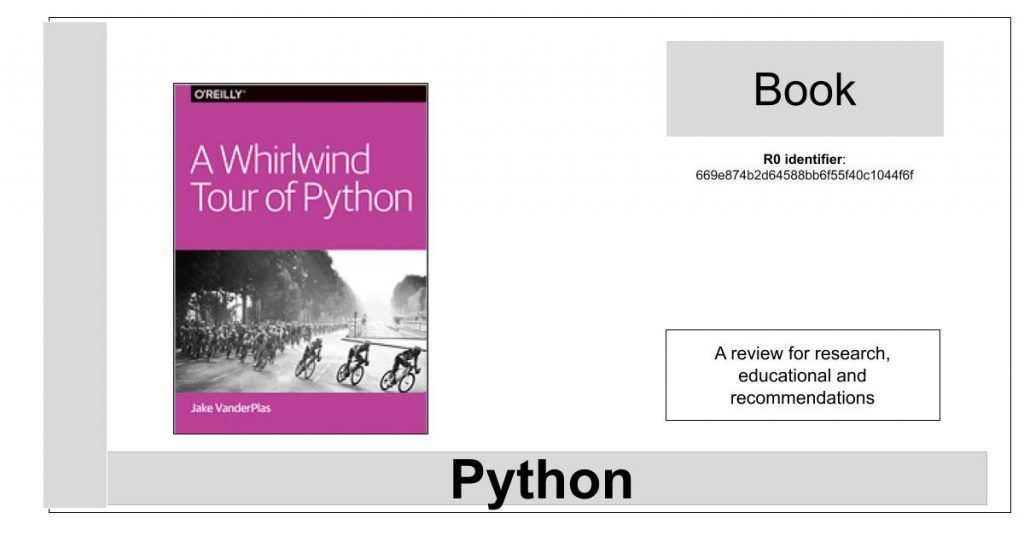
A Whirlwind Tour of Python

A Whirlwind Tour of Python is a fast-paced introduction to essential features of the Python language, aimed at researchers and developers who are already familiar with programming in another language. The material is particularly designed for those who wish to use Python for data science and/or scientific programming, and in this capacity serves as an introduction to my longer book, The Python Data Science Handbook.

https://editorialia.com/wp-content/uploads/2020/06/r-for-data-science.jpg

R for Data Science

This book will teach you how to do data science with R: You’ll learn how to get your data into R, get it into the most useful structure, transform it, visualise it and model it. In this book, you will find a practicum of skills for data science.

https://editorialia.com/wp-content/uploads/2020/06/r-notes-for-professionals-book.jpg

R Notes for Professionals book

This R Notes for Professionals book is compiled from Stack Overflow Documentation. (475 pages, published on May 2018)

https://editorialia.com/wp-content/uploads/2020/06/select-star-sql-2.jpg

Select Star SQL

This is an interactive book which aims to be the best place on the internet for learning SQL. It is free of charge, free of ads and doesn’t require registration or downloads. It helps you learn by running queries against a real-world dataset to complete projects of consequence. It is not a mere reference page — it conveys a mental model for writing SQL.